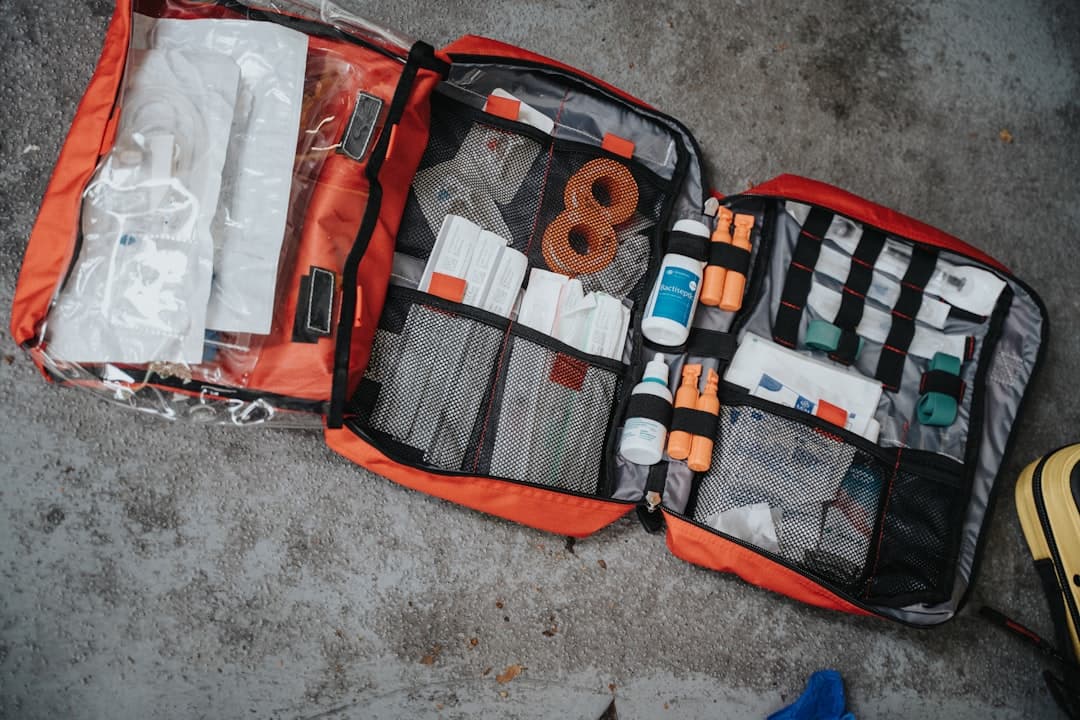
If your tactical kit weighs more than five pounds, you packed it for a YouTube video, not a callout.
The whole point of a TMK is that it rides on your plate carrier or in a drop pouch while you're already humping 25 to 50 pounds of armor, helmet, radio, and gas mask. Jim Morrissey, an FBI SWAT tactical paramedic, has been saying this for years. Every ounce you add is an ounce that slows you down getting to the patient.
So pack what stops the things that actually kill people in the warm zone: extremity hemorrhage, tension pneumothorax, an obstructed airway. MARCH is the order. MARCH is the kit.
Two tourniquets. Not one.
One CoTCCC-approved tourniquet is the floor. Two is the answer. Operators on a stack carry one accessible to either hand, and the Hartford Consensus was blunt: every responder at a mass casualty event needs a tourniquet, a hemostatic, and a pressure dressing on their person. Full stop.
The reason sits in a 496-patient military series: 96% survival when the TQ went on before shock, 4% when it went on after.
Four percent.
You don't get those minutes back.
For packing, carry combat gauze or another hemostatic, plus plain Z-fold for cavities the hemostatic can't reach. If you work areas where junctional bleeds are a real possibility (groin, axilla, neck shots), know that 19% of preventable battlefield deaths from 2001 to 2011 were junctional. The SAM Junctional Tourniquet lives in the team bag, not the IFAK. Don't pretend otherwise.
Airway and breathing: less than you think
Here's the change a lot of medics missed. TCCC Change 24-1 pulled supraglottic airways out of Tactical Field Care. The NPA stays. A 28Fr nasopharyngeal, lubed, in the kit. That's the airway tool for the warm zone now. If you've been carrying an i-gel in your IFAK out of habit, the guideline writers disagree with you.
For the chest: one vented seal (Russell or HyFin Vent) and one 14-gauge, 3.25-inch decompression needle. The RAMPART MARCH IFAK resupply bundles this combo and is a reasonable shopping list if you're building from scratch. Carry two seals if you've got the room. Entrance and exit wounds are a thing.
Circulation and the rest
TXA if your protocol allows it, within three hours. An 18g and an IO. Permissive hypotension is the move for penetrating torso, so you don't need a liter bag riding on your vest. A space blanket. Trauma shears. A Sharpie.
What doesn't belong in the TMK: a BVM, a full ALS drug box, a c-collar, anything you'd find on the truck thirty seconds after extrication. The kit is a bridge to the rig, not a replacement for it.
One last thing. The $300 multicam pouch with laser-cut MOLLE doesn't save lives. A vacuum-sealed insert in a $40 pouch saves the same lives and survives the wash cycle when someone bleeds on it. Spend the money on the second tourniquet.